Biomedical sciences foundation
Column Chromatography
An organic chemistry laboratory report from my time as a Biomedical Sciences major, focused on separating and identifying plant pigments.
CHEM 2071 • Organic Chemistry I Laboratory • Biomedical Sciences
See the complete work.
The complete artifact opens in a new browser tab for closer review.
Open the complete column chromatography lab report (PDF)Artifact context
From question to understanding.
The challenge
The experiment called for separating and identifying carotene and chlorophyll pigments extracted from spinach. The procedure required precise preparation of the silica column, careful solvent use, and enough concentrated pigment to collect distinct fractions.
My approach
- Prepared spinach pigment extract using magnesium sulfate and acetone.
- Conditioned the silica column and worked to remove trapped air bubbles.
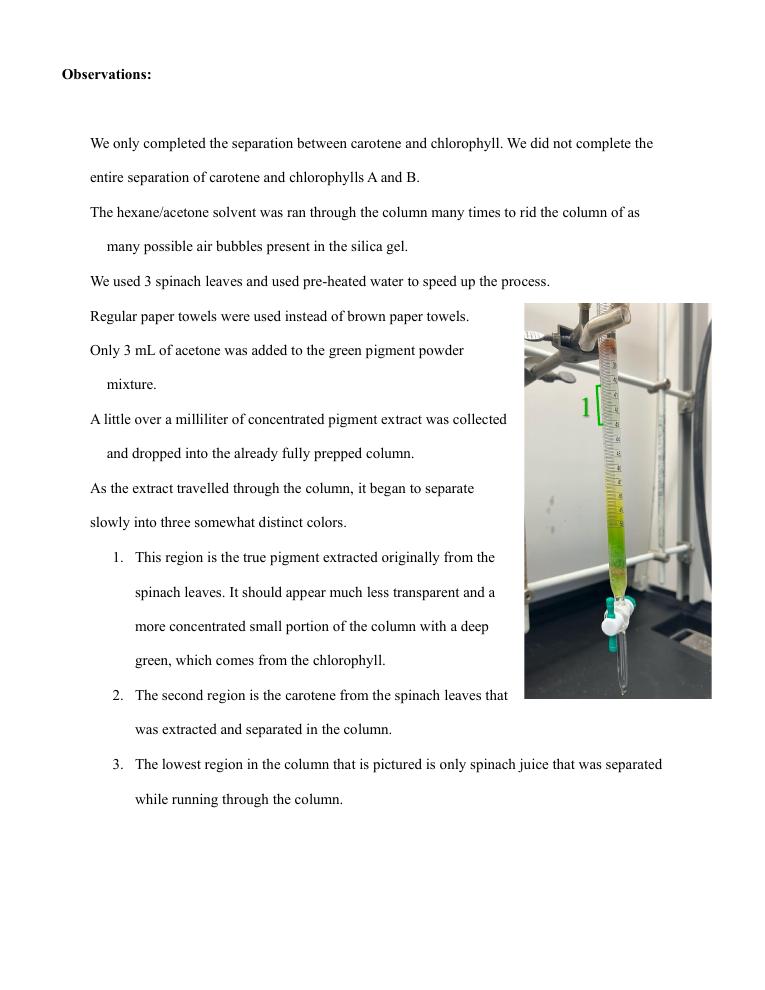
- Observed three color regions as the extract moved through the column.
- Documented deviations, partial results, and a specific improvement for another trial.
The result
Carotene and spinach juice fractions were collected, but the chlorophyll fraction was not concentrated enough to collect or separate into chlorophyll a and b. The report treats that limitation as evidence, not something to hide.
- Scientific observation
- Laboratory technique
- Documentation
- Reflective problem-solving
Artifact reflection
What? So what? Now what?
What?
I completed this CHEM 2071 laboratory report while I was a Biomedical Sciences major. The experiment used column chromatography to separate spinach pigments, and I recorded the preparation, visual changes, collected fractions, and the fact that the full chlorophyll separation was not achieved.
So what?
This artifact represents the scientific foundation I developed before transferring into Interdisciplinary Studies. The incomplete result made precision, concentration, and procedural clarity more visible to me. I learned that credibility depends on careful observation and honest interpretation, not on forcing every experiment into a perfect outcome. I still use that evidence-based mindset in my current degree and professional goals.
Now what?
If I repeated the experiment, I would begin with a more concentrated pigment extract, verify each measurement, and clarify the separation procedure before collection. Beyond the laboratory, I carry that same practice into administrative work: document accurately, identify limitations early, and propose a concrete next step.